At a time when geopolitical competition is intensifying and global supply chains are undergoing profound restructuring, localities can no longer rely solely on traditional forms of external engagement. International integration has increasingly become a prerequisite for accessing new markets, technologies, resources, and development opportunities. In this context, the issuance of a dedicated resolution on foreign affairs and international integration demonstrates the provincial leadership’s recognition of the strategic role external relations play in Tuyen Quang’s long-term development agenda.
One of the Resolution’s most notable features is its shift in perspective on foreign affairs. Rather than viewing external relations primarily as ceremonial or administrative work, the Resolution defines foreign affairs as a strategic instrument for creating a favorable environment, mobilizing external resources, and supporting socio-economic development. This approach closely aligns with the spirit of Resolution No. 59-NQ/TW of the Politburo on international integration in the new context.
The Resolution places foreign affairs at the center of the province’s broader development strategy. It reflects a transition from protocol-driven external engagement to development-oriented diplomacy, and from passive participation to proactive, comprehensive, and effective integration. In doing so, Tuyen Quang seeks to transform foreign affairs into a practical mechanism for attracting investment, expanding cooperation, improving governance capacity, and enhancing the province’s competitiveness.
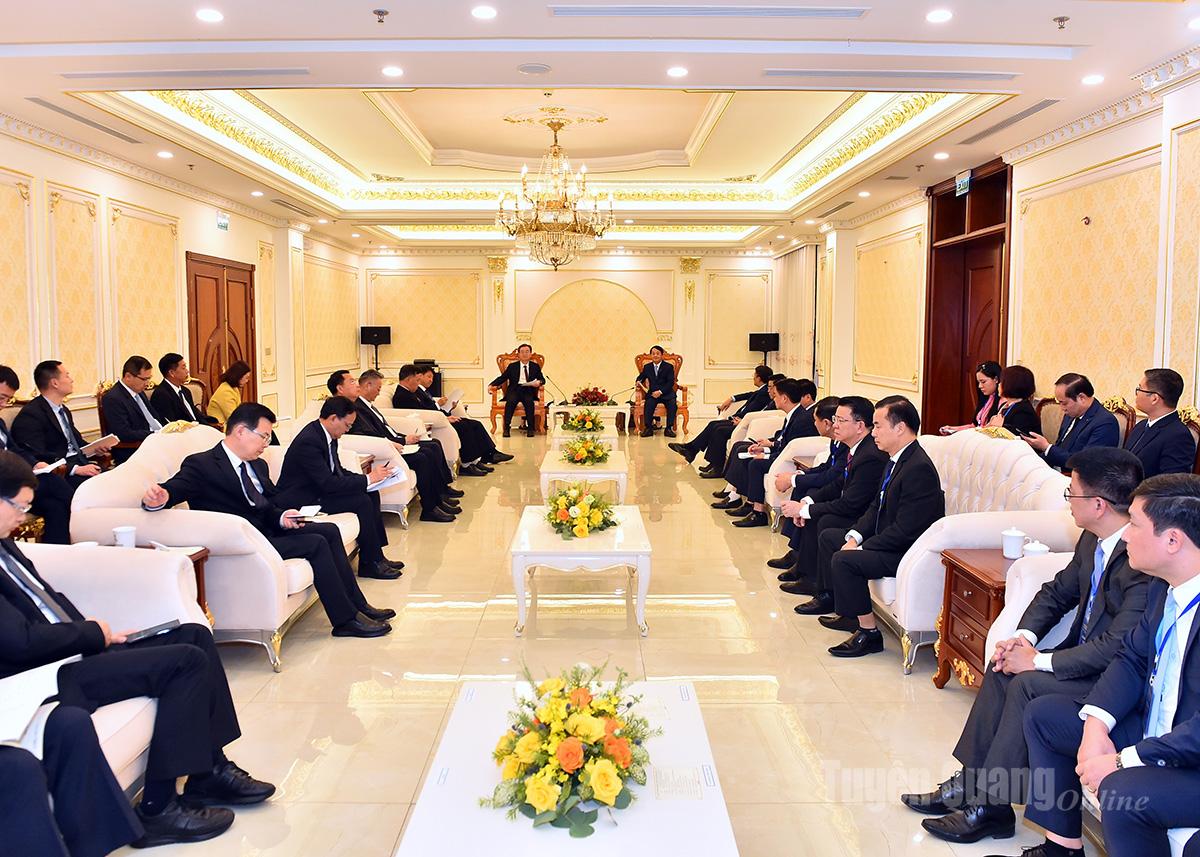
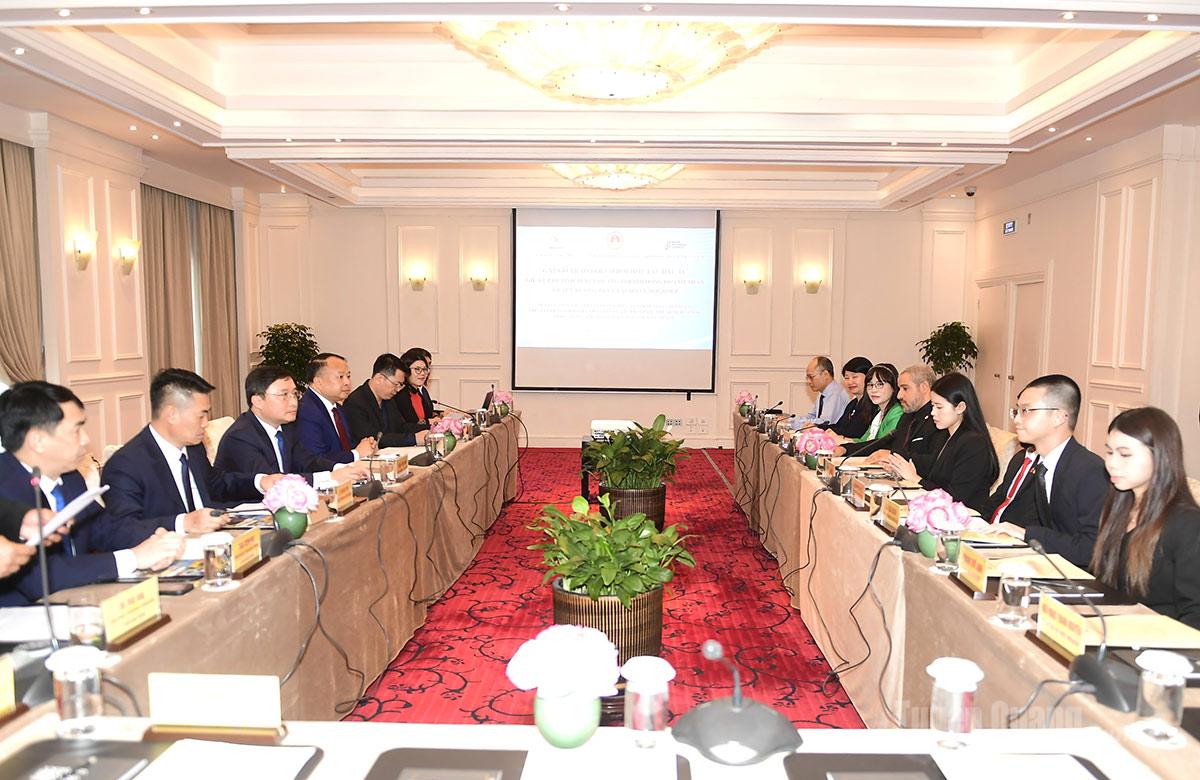
Mr. Hau A Lenh, Secretary of Provincial Party Committee held talks with Mr. Wang Ning, Secretary of the Yunnan Provincial Party Committee, China. (Photo by Tuyen Quang online)
Another important aspect of the Resolution is its emphasis on integrating foreign affairs and international integration into the province’s overall strategy for rapid and sustainable development. The Resolution highlights the close relationship between external relations, Party building, socio-economic development, national defense and security, and the strengthening of the political system. This reflects the consistent view that foreign affairs are not an isolated sector, but an integral part of the province’s comprehensive development framework.
The Resolution also demonstrates strategic depth through its emphasis on the coordinated implementation of the three pillars of Vietnam’s foreign policy: Party diplomacy, State diplomacy, and people-to-people diplomacy. This approach not only ensures consistency with the Central Government’s foreign policy orientation, but also reflects the determination to mobilize the combined strength of the entire political system and society in advancing international integration.
Rather than pursuing broad but superficial initiatives, Tuyen Quang emphasizes substantive effectiveness as the primary benchmark for evaluating foreign affairs activities. The Resolution seeks to avoid formalistic implementation that produces limited practical impact, instead requiring external engagement efforts to be closely linked to concrete development outcomes, investment attraction, trade promotion, tourism development, and improvements in people’s livelihoods.
The Resolution also reflects Tuyen Quang’s ambition to become a more active and dynamic participant in international cooperation. Its targets for 2030 reveal a clear development strategy: attracting between VND 15 trillion and VND 20 trillion in foreign direct investment (FDI), expanding partnerships with 10 - 20 international counterparts, launching 3 - 5 new international cooperation programs and projects, and enabling local enterprises to participate more deeply in global value chains and cross-border e-commerce.
Beyond these numerical targets is a broader vision of development: building a more open, modern, green, and competitive provincial economy. Tuyen Quang is seeking not only investment capital, but also access to advanced technologies, modern governance practices, innovative development models, and international standards capable of improving growth quality and long-term competitiveness.
Notably, the Resolution adopts a comprehensive approach to international integration. Beyond economic cooperation, integration is extended to culture, education, science and technology, healthcare, environmental protection, tourism, labor, employment, and digital transformation. This reflects an awareness that competitiveness in the modern era depends not only on capital and natural resources, but also on human capital, innovation capacity, and international connectivity.
The Resolution also highlights the importance of improving the capacity of foreign affairs personnel and strengthening governance for international integration. The target of providing annual training for all foreign affairs officials reflects an effort to build a workforce capable of meeting increasingly complex international requirements. At the same time, the commitment to reducing the processing time for foreign-related administrative procedures by at least 30 percent demonstrates a strong emphasis on administrative reform and institutional efficiency.
In essence, Resolution No. 83-NQ/TU represents more than a policy orientation for foreign affairs. It articulates Tuyen Quang’s broader vision for development in a new era of integration. The Resolution sends a clear message that the province intends to engage more proactively with the outside world, leverage external resources more effectively, and transform international integration into a catalyst for rapid and sustainable growth.
Building on its rich revolutionary heritage, distinct cultural identity, strategic location, and increasingly important regional connectivity, Tuyen Quang is entering a period of significant opportunity. Resolution No. 83-NQ/TU represents a strategic step toward unlocking new resources, expanding international partnerships, and enhancing the province’s position within broader regional and global networks.
Nguyen Thanh Hieu